Australia by rail
Australia train travel guide
Long-distance crossings, desert routes, and a handful of surprisingly affordable regional services.
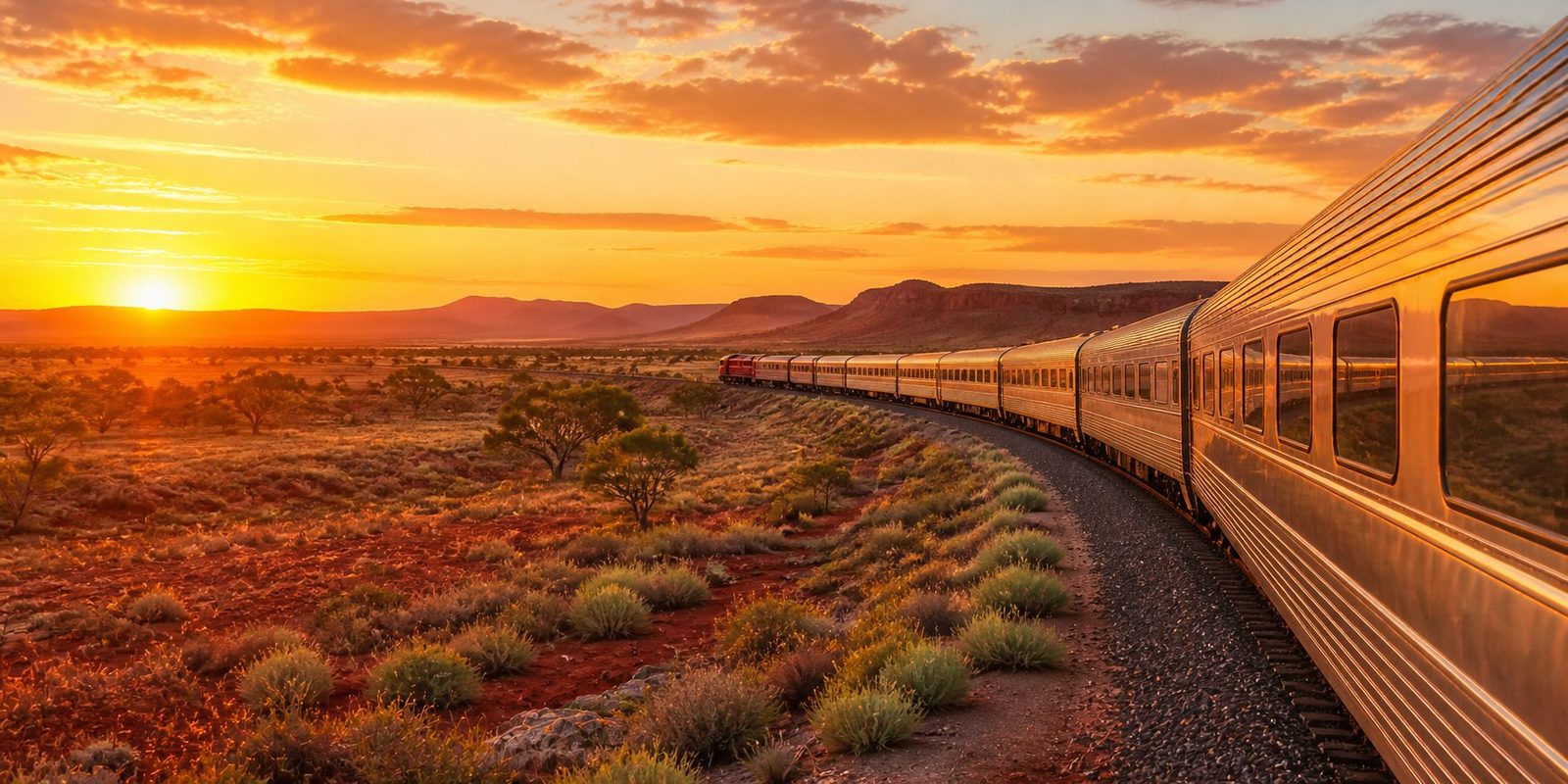
Train travel Australia: choose the right rail route
Train travel Australia is not like rail travel in Europe or Japan. The country is too large, the population is too spread out, and many routes were built for freight before passengers. That does not make Australian train travel weak. It means you need to choose the right kind of train for the right kind of trip. The Ghan, Indian Pacific, and Great Southern train are rail holidays with cabins, meals, lounges, and off-train experiences. The Kalgoorlie Prospector, NSW TrainLink XPT, V/Line, Transwa, and Queensland Rail services are practical regional trains. One is about the journey itself. The other is about getting somewhere without flying.
For most visitors, the decision tree is simple. Choose The Ghan if you want the Red Centre, Alice Springs, Katherine, and Darwin. Choose the Indian Pacific if you want the full east-west crossing between Sydney, Adelaide, and Perth. Choose the Great Southern train if you want a summer rail journey between Adelaide and Brisbane with coastal and inland stops. Choose the Kalgoorlie Prospector if you want an affordable Western Australian train trip from Perth to the goldfields. If you are searching for an Australia rail pass, know this first: there is no national Eurail-style pass. The most useful pass for travellers is usually the NSW TrainLink Discovery Pass, which works on eligible regional NSW TrainLink trains and coaches rather than every railway in Australia.
The slow way across a continent
Australia is a continent. Driving across it takes weeks and a lot of fuel. Flying skips everything in between, including some of the strangest country left on the planet. The third option is the train, and it's still here, still running, and still surprisingly comfortable.
Some of these journeys cost less than a domestic flight. Some cost more than a small holiday. All of them cross country you'd otherwise never see at ground level: the salt pans of the Nullarbor, the red middle of South Australia, the cane fields of north Queensland, the wheat belt outside Perth. The trains move at the speed of a slow bicycle. That's the point.
This page covers the long-distance services that are worth planning a trip around, the regional networks that get you between cities for a fraction of a flight, and the practical detail travellers actually want before they book.
The big four long-distance journeys
Four classic long-distance trains carry sleepers and dining cars and are run primarily as travel experiences, not commuter services. Three of them are operated by Journey Beyond, the same company behind several of Australia's other tourism rail products. The fourth, the Overland, is also Journey Beyond but works more like a regional train than a multi-day experience.
The Indian Pacific (Sydney to Perth, or the reverse)
The Indian Pacific covers 4,352 kilometres in either direction, taking four days and three nights. The route runs through Broken Hill, Adelaide, the Nullarbor Plain, the near-ghost town of Cook (its population has been counted in single digits for years), and Kalgoorlie before reaching the far coast. Departures are two or three times a week depending on the season.
The Nullarbor section includes the longest dead-straight stretch of railway track in the world: about 478 kilometres without a single curve. There's nothing to look at except sky and saltbush and the occasional stationary kangaroo, and yet most passengers say it's their favourite leg.
Off-train excursions are included in most fare classes. At Cook the train stops long enough to wander around the abandoned settlement and read a famous painted sign that says "If you're crook, come to Cook." At Kalgoorlie there's a night tour of the gold mining district. At Adelaide there's time for a city excursion.
The Ghan (Adelaide to Darwin)
The Ghan runs straight up the centre of the country: 2,979 kilometres from south coast to north coast, three days and two nights. The line passes through Alice Springs and Katherine. The train is named after the Afghan cameleers who supplied the inland routes from the 1860s onwards, before the railway existed.
The included excursion in Alice Springs is usually a half-day trip into the West MacDonnell Ranges or a sunset visit to Simpsons Gap. In Katherine the standard excursion is a cruise through the towering walls of Nitmiluk Gorge. The desert sections in between are some of the quietest country you'll ever see from a window.
The Great Southern (Adelaide to Brisbane, summer only)
The newest of the long-distance services, running only between December and January each summer. Three days and two nights, with overnight stops near the Grampians, Canberra, and the Hunter Valley. It's less famous than the Indian Pacific or The Ghan but covers a route that's hard to assemble any other way without a hire car and ten free days.
The Overland (Melbourne to Adelaide)
This one is daytime only. No sleepers, no overnight cabins. The train leaves either city in the morning and arrives in the other roughly 11 hours later. Tickets behave like normal long-distance train tickets, not like the bookable-experience model of the other three. It's the cheapest way to travel between Melbourne and Adelaide if you'd rather not fly, and it runs Mondays and Fridays.
Regional and commuter options
Beyond the long-distance services, every state has its own regional network, and several are worth knowing about if you actually want to move around.
The Prospector (Perth to Kalgoorlie)
The Prospector is the daily commuter and tourist train run by Transwa, Western Australia's regional transport agency. The trip from East Perth to Kalgoorlie-Boulder takes about six and a half hours and a one-way ticket runs roughly AUD 90 to 130 for a standard adult fare. Same destination as the Indian Pacific in WA, at a fraction of the price, with no overnight bunks. Reclining seats, a small cafeteria car, decent windows. If you only want to visit Kalgoorlie itself, this is the obvious way.
NSW TrainLink XPT
The XPT is a long regional train that runs Sydney to Brisbane (about 14 hours), Sydney to Melbourne (around 11 hours), and Sydney to Casino on the NSW north coast. It has reclining first-class and economy seats, plus first-class sleeper berths on the longer routes. A much cheaper way to travel between the eastern capitals than a flight if you have the time.
Spirit of Queensland (Brisbane to Cairns)
1,681 kilometres of east-coast Queensland in around 25 hours. Operated by Queensland Rail. There are RailBeds (sleeper-style flat seating), economy seats, and a dining car. Few people do this in one go for fun, but if you have the time and want to see the coast slowly, the views of the cane country and the Coral Sea are excellent.
Local rail networks
V/Line in Victoria, NSW TrainLink for regional NSW, Transwa in Western Australia, Queensland Rail Travel for Queensland, and Adelaide Metro and Transperth for inner-city work. These are the day-to-day networks that get you between smaller towns and capital cities. If you're going from Sydney to Bathurst, Melbourne to Bendigo, or Perth to Bunbury, this is what you'll use. Tickets are usually under AUD 50 one way and you can normally walk up and buy on the day.
Where and how to book
For the four long-distance services (Indian Pacific, Ghan, Great Southern, Overland), book directly through journeybeyondrail.com.au. The site shows availability up to twelve months ahead. Off-peak departures (typically late autumn and winter, May through August for most routes) are noticeably cheaper than peak-season travel.
For Transwa's Prospector and Australind, book at transwa.wa.gov.au. For NSW TrainLink (the XPT and regional NSW services), use transportnsw.info or nswtrainlink.info. For V/Line, vline.com.au. For Queensland Rail's Spirit of Queensland and other long routes, queenslandrail.com.au.
You don't need to be in Australia to book. International cards work fine on all the major sites and confirmations come through by email.
If you'd prefer a packaged trip, a few rail-focused operators sell the long-distance journeys with hotels and tours either side. Great Rail Journeys, APT, and Holidays of Australia all sell variants of the Indian Pacific or Ghan as part of broader itineraries. They cost more than the train ticket alone but they handle airport transfers and hotel logistics, which some travellers prefer.
Pricing, in real numbers
The figures below are typical 2025 fares in Australian dollars. Prices move around with the season and demand, so treat them as a starting point.
Indian Pacific (Sydney to Perth, four days): Gold Single (small private cabin, en suite shared) starts around AUD 2,300 per person. Gold Twin (private cabin with two beds, en suite) is around AUD 1,800 per person. Platinum (larger double cabin, premium meals) starts around AUD 4,500 per person. All three classes include all meals, drinks, and the off-train excursions.
The Ghan (Adelaide to Darwin, three days): Gold Single from around AUD 2,000. Gold Twin from around AUD 1,600 per person. Platinum from around AUD 4,000 per person. Same all-inclusive structure as the Indian Pacific.
Great Southern (Adelaide to Brisbane, three days, summer only): similar pricing to The Ghan, sometimes a touch higher because it's seasonal and books out fast.
The Overland (Melbourne to Adelaide, eleven hours): Red Premium tickets from around AUD 130, Red Service from around AUD 80. No overnight option since the train runs daytime.
XPT (Sydney to Melbourne or Sydney to Brisbane, around 11 to 14 hours): Economy seat from around AUD 90, first-class seat from around AUD 120, first-class sleeper berth from around AUD 230.
The Prospector (Perth to Kalgoorlie): standard adult around AUD 90, concession around AUD 45 for students, seniors, or pension cardholders.
Spirit of Queensland (Brisbane to Cairns): premium economy seat from around AUD 200, RailBed from around AUD 350.
Concession discounts apply on most regional services for seniors, students, and pension cardholders. International travellers don't qualify for these unless they hold an eligible card.
Stops worth knowing about
A few stops on these routes deserve advance attention either because they're part of the experience or because they reward structuring a trip around them.
Cook, South Australia on the Indian Pacific. Used to be a railway-worker township, now functionally abandoned. The train pauses long enough for passengers to walk around the empty buildings, take photos, and read the famous painted sign. Most residents left in 1997 when the railway was privatised.
Kalgoorlie-Boulder, Western Australia on both the Indian Pacific and the Prospector. A real working town, not a tourist stop, built on gold. The Indian Pacific arrives late at night, so on-train passengers usually only get a quick look. The Prospector terminates here and passengers actually have time to visit. Worth a day or two if you can spare it.
Alice Springs, Northern Territory on The Ghan. The desert capital. The Ghan stops for several hours in each direction, and the included excursions cover the West MacDonnell Ranges and a viewpoint at Anzac Hill. It's also a sensible place to break the trip if you want to see Uluru and Kings Canyon between the two legs.
Katherine, Northern Territory on The Ghan. Smaller than Alice Springs but the cruise into Nitmiluk Gorge that's included with the train fare is one of the best parts of the whole journey.
Broken Hill, New South Wales on the Indian Pacific. A mining town with a strong painting and arts scene, and some of the most extraordinary ochre-and-stone landscape in eastern Australia. The train stops a few hours here in the morning.
Adelaide sits on both the Indian Pacific and The Ghan. If you want to do both legs of a transcontinental crossing without flying, the easiest path is Sydney to Adelaide on the Indian Pacific, a few days in town, then Adelaide to Darwin on The Ghan.
What the trip actually feels like
Long-distance Australian rail is genuinely slow. The Indian Pacific averages around 65 kilometres per hour over the whole journey. You watch the country change at the speed of a slow bicycle and you're either OK with that or you're not.
There's a lounge car on every long-distance service, and meals are served in the dining car at fixed sittings (you'll be allocated an early or late sitting at boarding). WiFi is patchy or non-existent across most of the inland routes. Phone signal disappears for hours at a time across the Nullarbor and the central deserts. This isn't a complaint and it isn't a flaw. It's the design. The trains are for travellers who want time to look out the window. If you need to be reachable, this is the wrong format.
The off-train excursions at scheduled stops are included in most fare classes (Gold and Platinum on the long-distance services). They're optional but most passengers go on at least a few. Buses meet the train at each stop and run two- or three-hour tours of the area. Bring sturdy shoes. Some of the stops are dusty.